*This article was originally posted in September of 2025. However, there have been numerous reports of algal blooms in Walworth County Lakes recently. There have also been a number of posts on social media with opinions on the causes for these blooms. You will want to check reputable and reliable sources for information. One good source is the PLPRD website, where information is researched and fact-checked before publication. Other great options are the WI-DPI website and the Walworth County website. The PLPRD does not have a Facebook page and is not affiliated with any social media groups.
You may be aware that there have been conversations about blue-green algae on Potter Lake. Algal blooms are a common issue in Wisconsin's warm-weather months, typically mid-June through September, due to factors such as higher water temperatures, calm winds, sunlight, and nutrient pollution, especially phosphorus from fertilizers. All Wisconsin lakes contain blue-green algae, which may float up to the surface under low wind conditions.
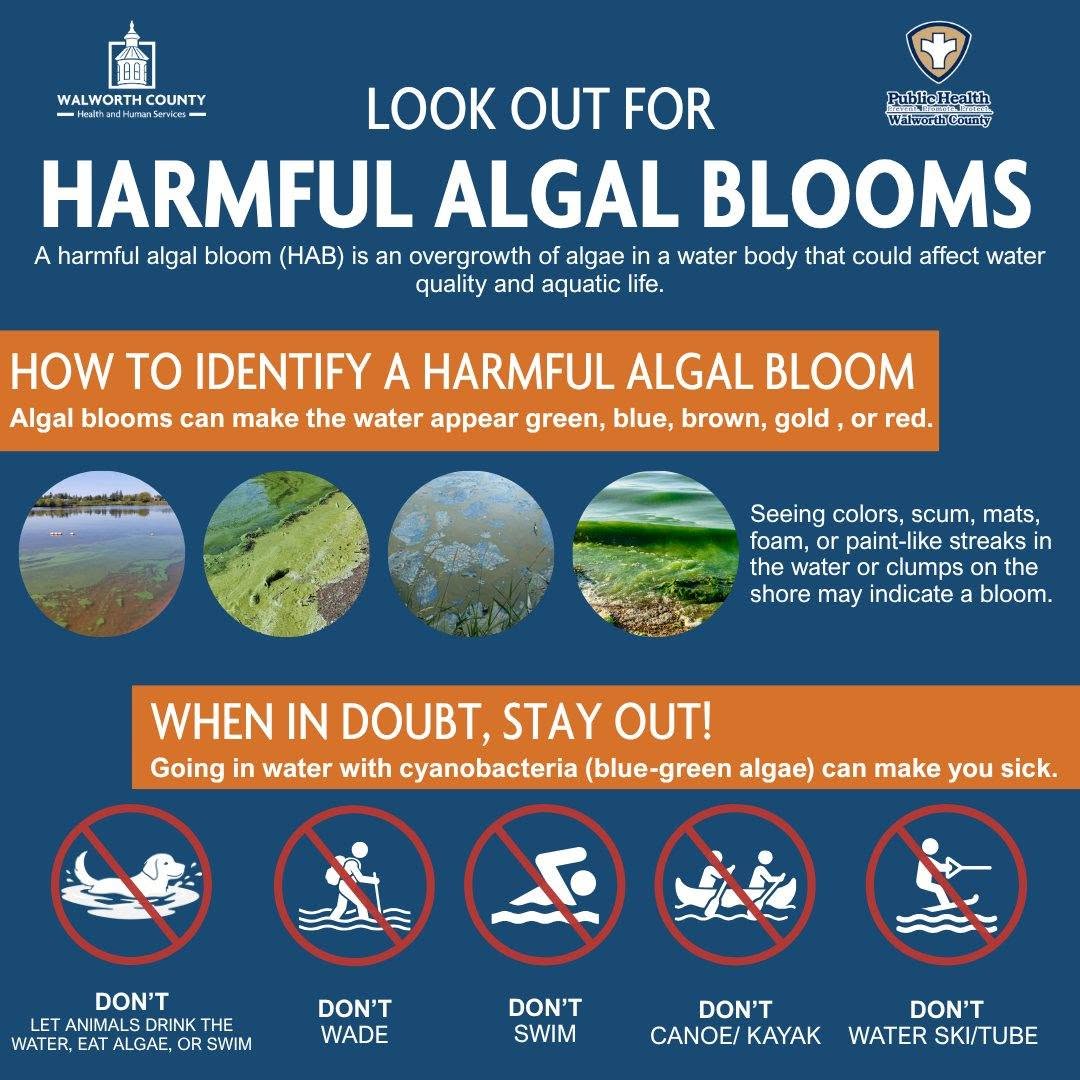
Residents are cautioned to avoid swimming or allowing young children or dogs in water with patches of algae that look thicker, like a swath of latex paint, or in water with many tiny particles floating in it. Of course, swallowing lake water is never a good idea. Not all blue-green algae make toxins, and those that do don’t make them all the time. Because it is impossible to tell whether a bloom is producing toxins by looking at it, it is best to err on the side of caution.
It is possible to test for the presence of harmful blue-green algae. However, blooms often dissipate on their own, so the best plan is to keep people and pets away until it is gone. In emails with a DNR representative who is an expert on algal blooms, she noted that more information can be found on the DNR's Blue-green Algae Page and DHS's Blue-green Algae Page. You can also view a 2021 Wisconsin Water Week DNR presentation on blue-green algae on YouTube.
If you have concerns about unusual algae blooms or other issues in Potter Lake, please contact the Lake District as soon as possible. The district will take the necessary action to work directly with its lake management consultant and the DNR to confirm whether observed blooms contain blue-green algae. This information can be communicated by the Lake District to appropriately reach the majority of the riparian owners and the community. Please understand that the Potter Lake Homeowners Facebook page is not affiliated with the Potter Lake District.
In speaking with our lake management consultant, he noted that if algae blooms are a recurring issue in a specific area, they sell and install horizontal circulators that attach to a pier to reduce stagnant conditions that favor growth. These must be installed at a height that does not disturb sediments. Please get in touch with me at chairperson@potterslake.org if you would like more information.
This graphic is from the Walworth County Department of Health and Human Services: